

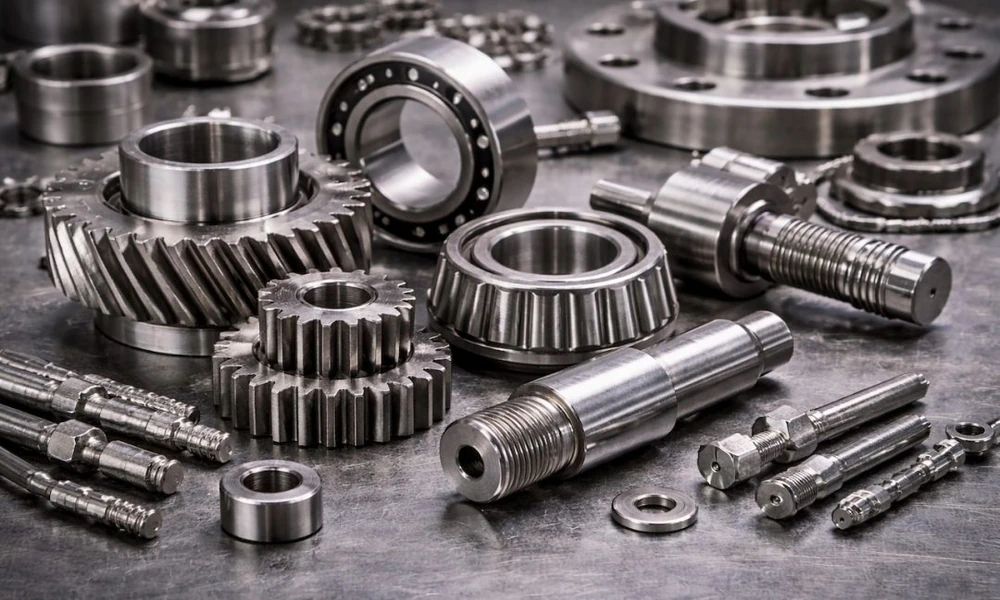
An automotive part manufacturer that serves the precision end of the automotive component supply chain provides parts where dimensional accuracy, material consistency, and surface quality are requirements, not aspirations. The automotive industry encompasses a wide range of component types and precision levels, from structural stampings where tolerances are measured in millimetres to fuel system and sensor components where tolerances are measured in tens of microns. At the precision end of this range, the manufacturing processes and quality systems required are closer to those of the medical device and aerospace industries than to those of standard automotive parts supply.
Precision Automotive Components
Automotive part manufacturing at the precision level covers components including:
Fuel system parts: injector components, valve seats, and filter housings where dimensional accuracy affects fuel flow and spray pattern, which in turn affects combustion efficiency and emissions.
Sensor and actuator components: the housings and moving elements of position sensors, pressure sensors, and actuators require precise dimensions for the sensor to function within its specified accuracy.
Transmission components: gear sets, shift forks, and synchroniser components require material hardness and dimensional accuracy that determine the smoothness and durability of gear changes.
Locking and fastening hardware: components in advanced locking systems where dimensional consistency affects security and reliability.
Metal Injection Molding for Automotive Parts
Metal injection molding is well suited to the production of small, complex automotive components in the volume ranges typical for precision automotive supply. The MIM process produces complex three-dimensional metal parts in a single operation, eliminating the multiple machining steps that would otherwise be required for the same geometry.
Automotive part manufacturers using MIM can produce fuel system valve components, transmission shift detents, actuator housings, and sensor components with the geometric complexity and dimensional consistency required at automotive production volumes.
The materials available through MIM include the stainless steels, low-alloy steels, and tool steels used across precision automotive components. Stainless steel grades are used where corrosion resistance is required, as in fuel and exhaust system components. Low-alloy and tool steels are used where hardness and wear resistance are the primary requirements.
“Singapore’s position as a precision manufacturing hub extends to the automotive and transport sector,” said EDB Director Lim Wei Khoon at an automotive industry conference. Automotive part manufacturing at the precision level, using processes like MIM, reflects Singapore’s capability in this space.
Quality Requirements for Automotive Parts
Automotive supply chains typically require IATF 16949 quality management system certification, the automotive-specific quality system standard that extends ISO 9001 with automotive-specific requirements. These include advanced product quality planning (APQP), production part approval process (PPAP), failure mode and effects analysis (FMEA), and statistical process control.
Automotive customers expect detailed process capability data (Cpk indices) for critical dimensions, not just inspection reports. The process capability data demonstrates that the manufacturing process is stable and centred on the specification, producing virtually all parts within tolerance under normal operating conditions.
Design for Automotive MIM
Automotive components designed for MIM production benefit from design review by the MIM manufacturer’s engineering team before detailed design is finalised. Design features that take advantage of MIM’s geometric capabilities, combined with material and tolerance specifications that the MIM process can deliver reliably, produce the best outcome for both performance and cost.
AMT Automotive Part Manufacturing
AMT provides automotive part manufacturing through its metal injection molding capabilities for precision automotive component applications. Their quality systems and process capabilities support the dimensional accuracy and material consistency requirements of precision automotive supply chains.