

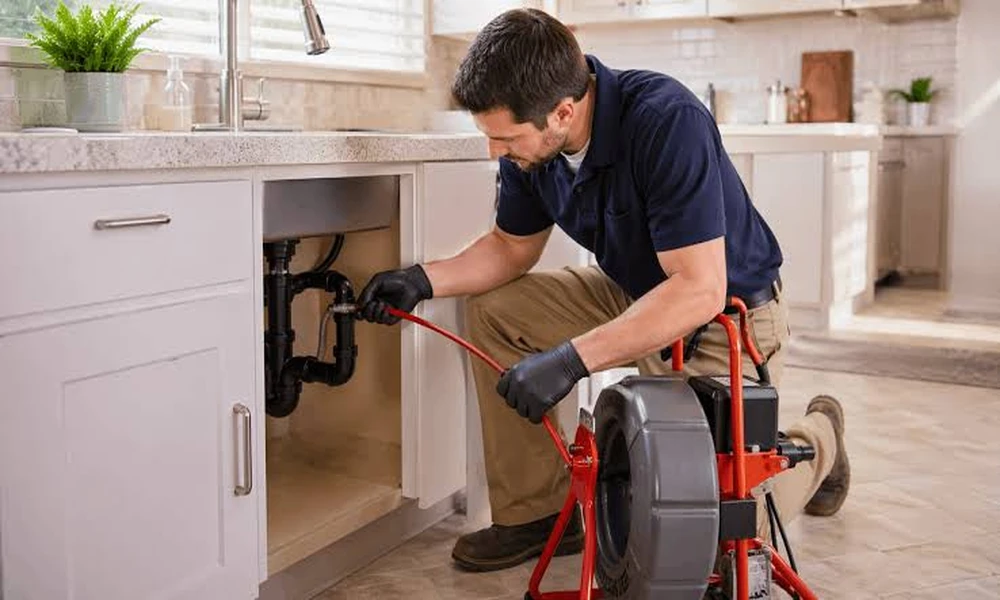
Drain lines in Las Vegas homes clog differently than drains in rainy, soft-water cities. Valley water carries a heavy load of calcium and magnesium. When that water mixes with kitchen grease, soap and detergent, it leaves a hard, layered crust on the inside of drain pipes. That crust narrows the pipe slowly over years. Then a single holiday meal or a load of towels finishes the job. The usual repair choices are a cable machine, often called a snake or rooter, and a hydro jet, which scours the pipe with high-pressure water. They solve different problems, and choosing the wrong one is the main reason a “cleared” drain backs up again within weeks.
The short answer to the title question is: partly. A cable machine can punch through a scale-and-grease blockage and restore flow. It rarely removes the crust lining the pipe walls. A jet can strip much of that lining away, but it is not the right first tool for every pipe or every home. The comparison below covers how each method works, where each one fits in valley homes, and how plumbers usually decide between them.
When a drain keeps coming back, it helps to work with a company that offers both approaches plus the repair work that sometimes follows. ProServ’s drains and sewers team handles routine drain cleaning, rooter service, and full mainline repair or replacement, so the method can be matched to the pipe instead of the truck. Anyone looking for a plumber in Las Vegas with that range and a 4.7-star Google rating can start on the company’s coupons page, which is worth a look before booking a drain visit.
How Each Tool Actually Clears a Line
A cable machine feeds a spinning steel coil into the drain through a cleanout or fixture opening. The head on the end bores into the blockage and breaks it up. Heads vary. A spear tip pierces soft clogs. A cutting blade slices roots. A bulb or spring head pulls out hair and debris. The result is an opening through the obstruction, often about the width of the cutter.
A hydro jet sends water through a hose to a nozzle with jets aimed backward and sometimes forward. The rear-facing jets drive the hose down the pipe while scrubbing the full inside wall. Residential jetters usually run at a few thousand pounds per square inch, with low enough water flow to work through a standard cleanout. Instead of a hole through the clog, the goal is a clean pipe from wall to wall.
Where Valley Homes Fit Into the Choice
Most tract homes built in the valley over the last several decades use ABS plastic drain and sewer pipe. ABS has a smooth bore and holds up well to both methods when it is in good condition. The surface is slick, so scale and grease bond to it less aggressively than to rough cast iron. That makes jetting especially effective at restoring near-original flow.
Older neighborhoods closer to downtown, built in the mid-century boom, often still have cast iron drains and sometimes clay sewer laterals. Cast iron corrodes from the inside, forming rough tuberculation that catches grease and scale. A jet can clean it, but a pipe that is already thin or cracked may not tolerate high pressure. In these homes, plumbers usually run a camera before choosing a method. When heavy scale needs removal in cast iron, some use chain knockers or specialty descaling heads on a rotating cable instead of water alone.
Grease adds its own complication. The Clark County Water Reclamation District identifies fats, oils, grease and grit poured down household drains as a leading cause of costly plumbing damage. In hard water, that grease does not stay soft. Minerals and soap scum bind with it into a waxy crust that a cable punctures but does not remove. This is the most common reason a kitchen line in the valley gets snaked repeatedly.
Side by Side
| Factor | Cable machine (snake or rooter) | Hydro jet |
|---|---|---|
| What it leaves behind | An opening through the clog; wall buildup stays | A scoured pipe wall along the cleaned run |
| Strongest use | Toilet obstructions, hair, a single solid blockage | Grease and scale lining, sludge, sand and silt |
| Hard water crust | Breaks through, leaves most of it in place | Removes much of it, especially in ABS |
| Tree roots | Cutting heads slice them fast | Root-cutting nozzles work, slower on thick roots |
| Older cast iron | Gentler, plus descaling heads for heavy scale | Effective but best after a camera check |
| Access needed | Fixture opening or cleanout | Usually a proper cleanout |
| Typical cost | Lower | Higher, often with a camera inspection added |
| How long results last | Shorter when the cause is buildup | Longer, since the lining is removed |
When a Cable Is the Better Call
A cable machine makes sense when the problem is one solid object or a localized clog. A toy in a toilet, a wad of wipes, or a hair mass in a tub drain usually clears in one pass. It is also the faster, cheaper first step when a line has never given trouble before. In older cast iron of uncertain condition, a cable avoids putting high water pressure on a pipe that might be cracked or thin.
Cables also handle roots well. Valley landscapes rely on irrigated trees, and roots tend to find small gaps at sewer joints where moisture escapes. A cutting head clears them quickly. Roots will regrow through the same gap, though, so this is a maintenance step rather than a permanent fix.
When Jetting Earns Its Higher Price
Jetting pays off when the same drain keeps backing up, when a kitchen or laundry line is slow along its whole length rather than at one point, or when a camera shows wall-to-wall buildup. Commercial kitchens use jetting on a schedule for this reason, and homes with heavy cooking or large households can benefit in the same way.
Jetting also makes sense before a sewer repair or a new lining. A clean pipe gives the camera a clear view, so the plumber can tell scale from a crack, a belly or an offset joint. Without that clear view, a repair quote is partly guesswork.
How the Decision Usually Gets Made
Drain work is guided by the Uniform Plumbing Code, published by IAPMO and adopted with local amendments across Southern Nevada. That code requires accessible cleanouts at set points in a drainage system. In practice, homes with a clear exterior cleanout give plumbers more choices, while homes where the cleanout is buried under pavers or landscaping often get a cable through a fixture by default.
A sensible sequence for a recurring clog is to clear the line first, run a camera, and then choose. Light buildup in sound ABS points to jetting. Roots at one joint point to cutting plus a plan for repair. Heavy scale in thin cast iron points to mechanical descaling or replacement. In valley homes, the cable answers “is it open?” and the jet answers “is it clean?” Most recurring drain problems here need both questions answered.